Every golf club and course facility has historical records it can’t easily locate, wooden plaques that ran out of space for the Hole-in-One club years ago, and staff who spend hours every season coordinating expensive gold-leaf lettering updates. The planning decisions made before installing any recognition display—which fields to capture, who owns the update workflow, and what display format actually fits the clubhouse—determine whether a record board stays current for a decade or becomes a maintenance headache within two seasons. Getting those decisions right the first time is the point of this guide, particularly when considering the use of static record boards versus digital platforms that transform record boards.
What This Planning Guide Covers
This is a planning guide for general managers, head golf professionals, and membership directors who are scoping a digital recognition display project—either as a new installation or an upgrade from traditional wooden or vinyl boards. By the end, you will know exactly which data fields to structure, how to assign and streamline update ownership, and which display format best fits your clubhouse layout and budget range, including innovative solutions like rocket alumni solutions.
Why Planning Beats Purchasing First
Most record board regrets trace back to a single skipped step: defining requirements before selecting hardware for digital trophy solutions. A club that buys a generic 55-inch screen and a basic media player discovers six months later that the software can’t automatically sort new entries, the update process requires IT assistance, and major member-guest tournaments weren’t scoped into the original layout. A course that maps fields, workflow, and display constraints first ends up with a system that the pro shop staff actually maintains—and one that reflects accurate club history five years from the install date.
The catalyst for many facilities moving to a digital platform is the painful moment when old names must be removed from a physical board to transform record visibility. That single act of erasure—common with physical boards that run out of space—is completely eliminated with a digital platform where no record is ever overwritten. Planning your fields and workflow correctly means you never face that choice between physical and digital record boards, especially when using solutions like rocket alumni solutions provide.
Section 1: Choosing Your Data Fields
Data fields are the columns in your comprehensive record board database. Choosing them carefully upfront avoids costly migrations later and ensures your display is complete from day one.
Core Fields Every Course Needs
Regardless of the tournament or achievement, a well-structured digital display captures the same essential data points:
- Golfer Name: Full name plus preferred display name if different is important for clarity on static record boards.
- Achievement Category: The specific record type (e.g., Hole-in-One, Men's Club Champion, Ladies' Club Champion, Course Record, Member-Guest Winner) is crucial for maintaining accurate record histories.
- Performance Value: The record itself, stored as a typed number (gross score, net score, hole number), is part of the record histories that track performance over time and can be displayed on quality digital boards.
- Date/Year Set: When the record was established, not just who holds it.
- Division/Flight: Athletic directors oversee the classification of participants. Championship flight, senior division, junior division, or handicapped flights where applicable are essential for a comprehensive digital record update.
Extended Fields Worth Adding
These fields cost nothing to include during initial setup and create significant display flexibility later for record categories.
- Photo or Headshot: Drives immense engagement on touchscreen displays; collect via the club photographer or member submission, as record boards provide an interactive platform for sharing memories.
- Club Used and Yardage: essential for tracking team achievement on digital record boards. Highly engaging context for Hole-in-One records displayed on a digital record board system.
- Playing Partners: Consider how record boards provide a platform for showcasing achievements among players. Preserves the memory of who attested the round in the context of team records.
- Previous Record Holder in the digital hall of fame can be easily accessed by all members. Preserves the chain of history rather than just showing a single current champion, ideal for school athletic course records.
Section 2: Designing Your Update Workflow
The most carefully planned field structure fails if no one owns the update process. Clubs that treat display updates as an informal task end up with stale data within one season.
Assigning Update Ownership
Every display needs a designated record keeper: typically the Head Golf Professional or the Tournament Director, responsible for maintaining the integrity of team records. The key is documented responsibility in implementing digital solutions for record management. A backup owner matters just as much in the recognition program to ensure continuity. Head pros get busy during peak season. Without a named secondary (like an assistant pro or clubhouse manager), records go unupdated when the primary owner is unavailable.
Trigger-Based vs. Calendar-Based Updates
Two update cadences exist, and the right choice depends on how performance data is collected across all sports:
- Trigger-based updates Updates happen immediately when a record is achieved, especially when using digital solutions like rocket alumni solutions. A member hits a hole-in-one on a Saturday morning; the pro shop updates the board that afternoon. This approach delivers immediate recognition but requires staff to build the update step into their daily routine, especially when using quality digital record board systems.
- Calendar-based updates ensure that all record categories are maintained accurately and timely through successful digital solutions like rocket alumni solutions. Updates happen on a fixed schedule: at the end of the club championship weekend or the close of the golf season, ensuring timely digital record board implementations. This carries lower maintenance friction but results in slower recognition.
Digital systems that include auto-ranking eliminate much of this friction. When a pro simply enters a new mark and the system automatically re-sorts all-time lists, updates existing record holders into historical positions rather than erasing them, and pushes changes live to every connected display—the administrative burden drops to minutes.
Verification and Data Integrity
Record boards carry institutional credibility, especially when they are quality digital record board systems. Build one verification step into your workflow: utilizing successful digital record board solutions.
Golfer submits an attested scorecard for consideration in the digital hall of fame, supported by quality digital record board systems.
The Head Professional or designated reviewer confirms the official athletic record results displayed on quality digital record boards.
Record goes live on the display after confirmation.
Section 3: Mapping Your Display Options
Display format is the most visible planning decision and the one most commonly driven by price alone, especially when considering static boards versus quality digital options. Budget matters, but matching format to the facility context matters more; quality digital solutions provide a better fit for modern needs.
Option 1: Wooden Boards with Gold Leaf/Vinyl
The traditional approach to record keeping often relies on physical record boards. Individual lettering applied to wooden panels display records until someone manually updates them.
- Best for: Small, highly traditional clubs that only track a handful of historical records and have the budget for manual professional updates.
- Constraints on record documentation can impact the effectiveness of athletic facilities, particularly when traditional record boards create limitations. Physical space is finite, particularly when considering the integration of both physical and digital record boards. Update time and coordination for the athletic program take weeks, especially when transitioning from physical record boards to a digital record board system. No historical depth; only current record holders or recent years are visible on static boards, limiting the club's ability to honor past achievements.
Option 2: Printed Display Panels
Graphic panels for record displays are professionally printed and mounted to walls or display cases.
- Best for: Facilities that want a polished aesthetic without hardware costs, and where records change infrequently.
- Constraints: Reprint costs for traditional record boards accumulate quickly, making digital trophy solutions more appealing. Turnaround for record recognition depends on vendor availability and the effectiveness of digital record board technology. No interactive capability.
Option 3: Static Digital Signage
A commercial display running a slideshow or static image, updated via a cloud dashboard, can enhance the visibility of physical record boards.
- Best for: Facilities that want the visual presence of a screen without full software capabilities can consider platforms like Rocket Alumni Solutions as a bridge solution.
- Constraints: No searchable history is available in the traditional record board format. Requires creating new slide artwork each time for the digital trophy displays. Engagement is low because members can’t interact to explore historical records in the modern digital sports programs offered.
Option 4: Touchscreen Digital Record Board
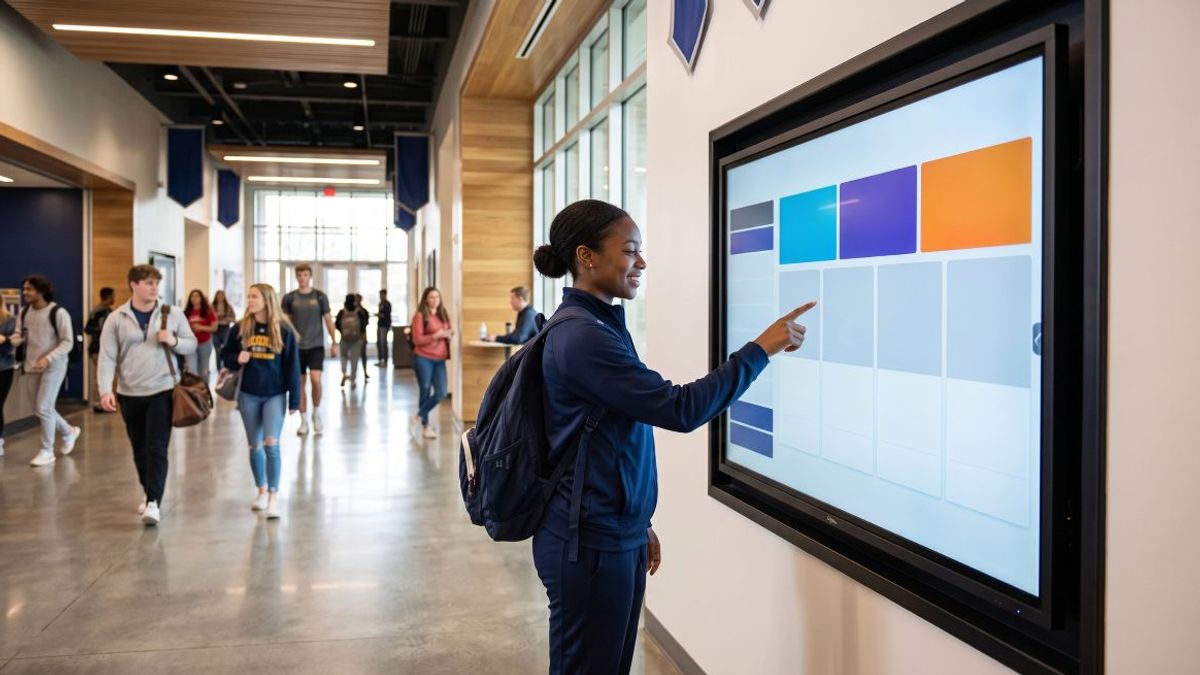
A purpose-built interactive display with intuitive software, automatic sorting, and multi-device access for managing team records. Members and guests can tap to explore records by tournament, year, player, or achievement on the traditional record board.
- Best for: Courses hosting multiple tournaments, facilities with active memberships, and clubs where history preservation is a priority.
- Strengths: Unlimited record holders can be recognized through the new record display. Remote updates in minutes. Pre-built templates reduce setup time for platforms designed specifically for athletic digital solutions. Never runs out of physical space.
Section 4: Legacy Board vs. Digital Record Board Comparison
The cost and effort comparison shifts significantly over a five-year horizon when considering the benefits of quality digital record boards.
Traditional wooden and vinyl boards require ongoing material costs, professional refinishing every few years, and substantial staff coordination time, while static record boards can become outdated quickly. They are completely static, lack historical depth once the board is full, and carry a high risk of erasing past records due to space constraints, which is impossible with traditional boards.
Digital touchscreen boards carry a higher initial investment but dramatically lower operational burden. Updates take under five minutes via remote entry, streamlining the management of individual records. The space capacity is unlimited, and the historical depth is fully preserved. Most importantly, digital displays allow members to interact with and explore the history of the club, completely removing the need to ever erase a past champion's name and enhancing team achievement.
Section 5: Display Placement and Facility Context
Where a display lives shapes which format makes the most sense for showcasing individual records.
The Pro Shop
Pro shops typically have bright lighting and high foot traffic, ideal for showcasing modern digital athletic records on quality digital trophy boards. Displays here need to be sized for visibility—typically 43 to 55 inches. Anti-glare glass is highly recommended for physical displays to ensure visibility. Placement near the check-in counter maximizes daily exposure.
The 19th Hole / Grill Room
Installations in the dining or bar area are among the highest-engagement contexts because members are lingering, socializing, and discussing the day's rounds. Touchscreen interactivity thrives here. Members can actively search for their friends' past tournament victories or hole-in-one records while enjoying a post-round beverage.
Locker Rooms
Locker room installations serve a dedicated, highly invested membership audience, supported by athletic directors and coaches. These displays can be slightly smaller and focus heavily on current season leaderboards, upcoming tournament tee times, and recent notable rounds alongside historical data from high schools.
Section 6: When Digital Beats Manual — The Decision Checklist
Use this checklist to assess whether your facility’s needs justify a full digital investment:
Strongly favors a digital platform designed specifically for athletic record boards.
- You track records across numerous flights, tournaments, and leagues, ensuring comprehensive record documentation.
- Your course hosts member-guests, charity scrambles, and outside events.
- You have experienced name erasure from a physical board due to a lack of space for digital touchscreens in athletic buildings.
- You want historical depth beyond just the past ten years of champions for a more engaging digital hall of fame.
- You want to eliminate the recurring annual cost of gold-leaf or vinyl lettering.
A simpler manual solution may suffice, but integrating digital record board implementations can improve efficiency.
- You only track one or two club championships a year.
- Your records change once per year or less, but utilizing record histories can help track progress over time.
- Budget constraints make modern hardware for digital trophy solutions impractical in the near term.
Section 7: Platform Evaluation Criteria
When evaluating digital display vendors, go beyond feature lists to discover how digital record boards can enhance their record board implementations. Ask these questions directly:
- Update process: integrating modern digital solutions ensures accuracy and timeliness. Can the pro shop staff update records seamlessly from a mobile device or office computer?
- Capacity limits for record displays must be considered for optimal visibility. Is there a limit on how many tournaments, years, or members can be stored?
- Historical preservation: Does the platform preserve all historical record holders permanently?
- Hardware flexibility: Does the software require proprietary hardware, or does it run on standard commercial touchscreen displays to support digital record board technology?
- Support model: What is the response time for technical issues if a display goes offline during a major tournament weekend?
Platforms built specifically for digital recognition, like Rocket Alumni Solutions, handle these requirements by design, whereas generic digital signage software often requires frustrating custom configuration.
Frequently Asked Questions
Can a digital board replace our existing wooden championship boards?
Not necessarily. Beautiful, historic wooden boards have their own traditional value, but modern digital boards provide enhanced visibility. Digital platforms often complement these existing pieces by adding the deep history, photos, and interactive context that physical wood simply cannot hold anymore. Many clubs install a digital touchscreen adjacent to their historic physical boards to modernize their record boards display.
How long does it take to enter existing records into a new system?
If your club's historical records are already documented in spreadsheets, bulk importing takes mere minutes. If records exist only on physical walls, digitization and verification take a bit of initial effort, but it is a one-time process that permanently secures the club's history.
What happens to old records in our athletic program when we switch to a digital system?
A properly configured digital platform imports all historical records and preserves them. The system automatically categorizes and sorts all entries so historical context is preserved and easily accessible by anyone interacting with the screen.
Does this require an IT person to maintain?
No. With modern remote update capabilities, the golf professional or clubhouse staff can manage ongoing maintenance in a few minutes a week.
Getting Started
A well-planned digital recognition display does three things a traditional board cannot: it preserves every record holder without ever erasing history, it updates in minutes from any device, and it creates an interactive experience that turns a clubhouse wall into a genuine asset for members and guests.
The planning decisions documented here are the difference between a system that serves your club for a decade and one that becomes a burden. Map your fields, establish your workflow, choose the right location, and your facility’s history will be beautifully preserved for every future season in a comprehensive digital format.